From shoebox to clear position: what catch-up bookkeeping fixes
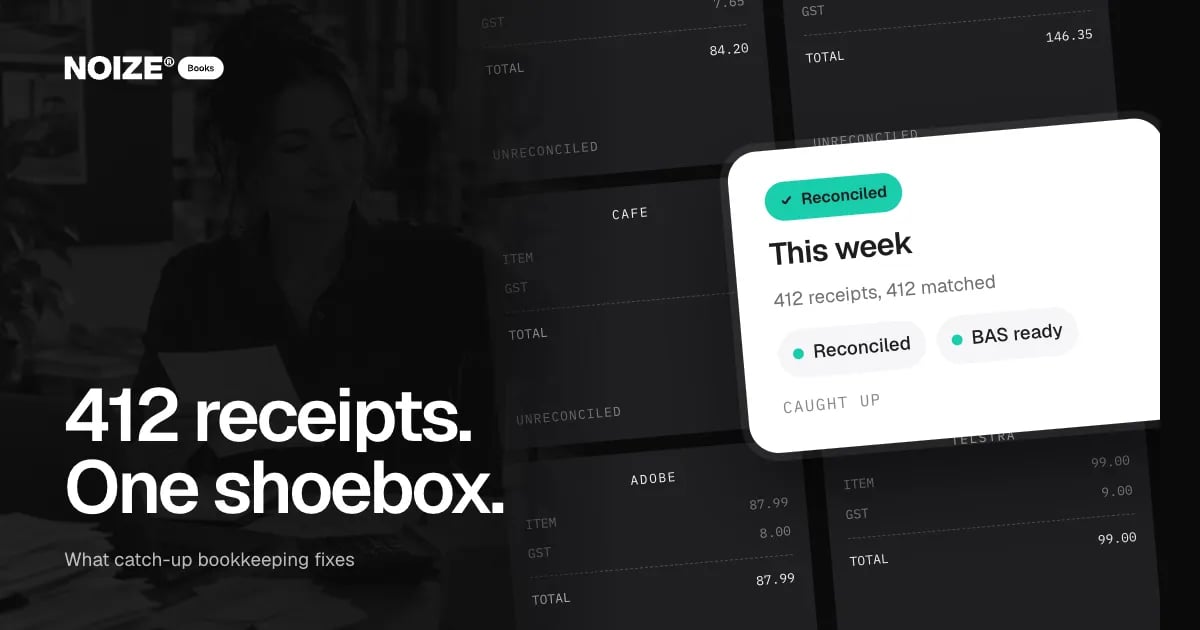
The receipts are in a shoebox. Actually, there are two shoeboxes, a drawer and a folder of email attachments. The bank feed hasn't been reconciled for months. The BAS is overdue, and every week of delay makes it harder to start.
Falling behind on bookkeeping is common. It happens to good businesses run by busy owners, usually during a growth spurt, a staff change or a tough year. The hardest part isn't the work itself. It is knowing where to begin.
The short version
- Catch-up bookkeeping brings books that have fallen behind back to a clear, current position.
- It gathers what exists, reconciles accounts, codes transactions, lodges anything overdue and fixes the setup so the problem doesn't return.
- Then weekly bookkeeping keeps it current.
- The result is relief first, then visibility: you finally know where you stand.
How catch-up bookkeeping works
01Assess
Work out how far behind the books are, what records exist and what is overdue.
02Gather
Collect bank statements, receipts, invoices, payroll records and any other documents.
03Set up properly
Fix the chart of accounts, connect bank feeds and set rules for common transactions.
04Reconcile
Match every transaction to the bank and card statements.
05Code and clean up
Categorise transactions correctly, fix errors and resolve duplicates.
06Lodge
Prepare overdue BAS for lodgement through an appropriately registered professional, and hand to Accounting for any overdue returns.
07Move to weekly
Once current, weekly bookkeeping keeps it that way.
What gets in the way
- Missing records. Most can be recovered from banks, suppliers and email.
- Embarrassment. Many owners delay because they feel they should have kept up. There is no judgement. It is a common problem with a clear fix.
- Uncertainty about what is owed. Getting the books current is the only way to find out, and it is usually better than feared.
> I've invested in businesses that put off catching up their books for a year because they were worried about what they'd find. In almost every case, the reality was less frightening than the uncertainty. Once the numbers were clear, the decisions got easier immediately.
“Things really got moving beyond our expectations.”
Preventing it from happening again
Catch-up is a one-off when the setup is fixed. Connected bank feeds, digital receipt capture, rules for common transactions and a weekly bookkeeping rhythm stop the backlog forming again. Many clients say the biggest change is no longer having bookkeeping in the back of their mind.
An illustrative example
Picture a small construction business nine months behind with two overdue BAS lodgements. Books gathers bank statements and supplier invoices, reconciles nine months of transactions, sets up receipt capture and bank rules and prepares the overdue BAS. Within weeks, the business is current. Weekly bookkeeping starts, and the owner sees their real position for the first time in a year.
Mistakes to avoid
- Don't wait until everything is found before starting. Begin with what you have.
- Don't try to catch up and keep up on your own at the same time.
- Don't skip fixing the setup, or the backlog will return.
How NOIZE Books works with you
Most of what this article covers is practical work NOIZE Books takes on: preparing monthly reports, reconciling accounts and entering bills and invoices. You get our view on from shoebox to clear position too, not just the paperwork.
If a job needs a registered agent, such as for lodgements, we involve an appropriately qualified professional with the right accreditation. The right mix is decided with you when we scope the work.
Questions to ask before a catch-up
- How many months are unreconciled?
- Which BAS periods are overdue?
- Where are receipts, invoices and statements kept?
- Which bank and card accounts does the business use?
- Is the accounting software set up properly?
- Who will keep the books current once caught up?
Knowing these answers makes the catch-up faster and more accurate.
What good looks like
All accounts are reconciled to the bank. Transactions are coded correctly. Overdue BAS is prepared and lodged through an appropriately registered professional. Bank feeds and receipt capture are set up. Weekly bookkeeping begins immediately, so the backlog never returns. The owner sees an accurate picture of the business, often for the first time in months.
Where to start this week
Find your most recent bank statement and note the last reconciled date in your accounting software. The gap between them is the size of the catch-up. See books.noize.com.au.
How Books connects to the rest of NOIZE
This is where the wider NOIZE group makes a difference. NOIZE Strategy uses the numbers to test which priorities the business can afford. NOIZE Talent relies on payroll being set up correctly for every new person. When Books sits inside the same group, the records are ready for whoever needs them next. NOIZE Accounting relies on clean records to plan, forecast and advise, with appropriately registered professionals handling regulated lodgements. NOIZE Finance uses current books to build funding packs that brokers and lenders take seriously.
Related reading
This article is general information only. It is not legal, tax or financial advice, and it does not take your circumstances into account. Speak to a qualified adviser before acting.
NOIZE provides administrative support and business strategy. Where work is outside our skillset, or the law requires it, we make sure an appropriately qualified professional is involved.
Common questions
What is catch-up bookkeeping?
Bringing books that have fallen behind up to date by gathering records, reconciling accounts and lodging anything overdue.
How long does catch-up bookkeeping take?
It depends on how far behind and how many transactions there are. Most catch-ups are completed in weeks.
What if I have lost receipts?
Many records can be recovered from banks, suppliers and email. We work with what is available.
Can you lodge overdue BAS?
Overdue BAS is prepared and lodged through an appropriately registered professional, and Accounting can help with overdue returns.
Will I get penalties for being late?
Possibly, but getting current quickly limits further penalties. Your accountant can advise on your situation.
Do I need to change software?
Not necessarily. We often work in your existing software or help set up Xero.
What happens after the catch-up?
Weekly bookkeeping keeps the books current.
What do you need to start?
Your software, your transaction volume and how far behind you are.
Can NOIZE Books lodge our BAS?
We prepare everything from current books. Lodgement is handled through an appropriately registered professional where the law requires it.
Can catch-up and weekly bookkeeping start together?
Often, yes. We catch up the past while keeping the current weeks reconciled.
Will catch-up bookkeeping find money I'm owed?
Sometimes. Reconciling often reveals unpaid invoices, duplicate payments or unclaimed expenses.
How much does bookkeeping cost?
It depends on transaction volume, payroll and how current the books are. We scope it after a short conversation.
Can I see my numbers any time?
Yes. With cloud software, your books are available whenever you need them.
Do you handle accounts payable?
Yes. Entering and scheduling supplier bills is part of NOIZE Books.
Do you chase overdue invoices?
Yes. Following up accounts receivable is part of keeping cash healthy.
Do you work with software other than Xero?
We work mostly in Xero and can advise on moving from other platforms where it makes sense.
Your first strategy conversation is on us.
Have a chatThe brand for business.